
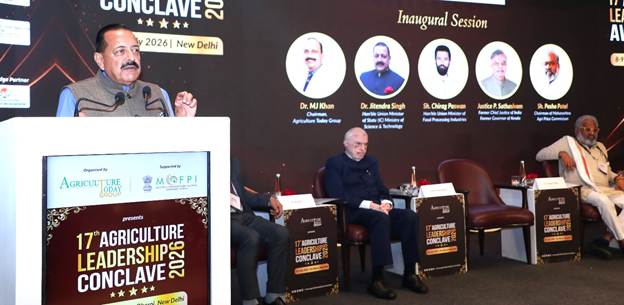
Union Minister of State (Independent Charge) for Science & Technology Dr. Jitendra Singh today said that Artificial Intelligence (AI) holds promise of manifold increase in India’s Agriculture Economy which, according to one estimate , could be to the tune of around Rs 70,000 crore addition to the existing annual agricultural economy.
Calling Agri-Startups the defining force of India’s agricultural future, the Minister said, the next wave of India’s StartUp revolution must emerge from farms rather than only from technology hubs, enabling agriculture to become a major source of entrepreneurship, employment and wealth creation.
Dr. Jitendra Singh was addressing the 17th Agriculture Leadership Conclave 2026, organised with the support of the Ministry of Food Processing Industries in New Delhi. The conclave brought together policymakers, farmers, scientists, entrepreneurs, industry leaders, startups and innovators to deliberate on the future of Indian agriculture under the theme, “Feeding the Future.”
Dr. Jitendra Singh said India has witnessed an extraordinary transformation in its startup ecosystem over the last decade, growing from nearly 350 registered startups in 2015 to over 2.3 lakh startups today, making the country the third-largest startup ecosystem in the world. However, he remarked that the true potential of this movement lies in agriculture, where innovation can directly improve farmers’ incomes while creating employment for rural youth.
The Minister said the perception that startups are confined to information technology, metropolitan cities or highly qualified professionals needs to change. Agriculture, he said, offers one of the largest opportunities for entrepreneurship in India, where practical knowledge, innovation and willingness to learn are often more valuable than academic qualifications alone. Government support, digital learning platforms and scientific institutions have made technology increasingly accessible even in rural areas.
Sharing the success of the CSIR Aroma Mission, Dr. Jitendra Singh described how lavender cultivation initiated in the villages of Jammu & Kashmir evolved into the widely recognised Purple Revolution, creating new livelihood opportunities for thousands of young entrepreneurs. He said nearly 8,000 to 9,000 youth associated with the initiative have established successful agri-enterprises, with several earning annual incomes of minimum Rs 60-70 lakh and more. The model has since been adopted by several Himalayan and North-Eastern States including Uttarakhand, Himachal Pradesh, Arunachal Pradesh and Nagaland, demonstrating the immense potential of science-led agricultural entrepreneurship.
Dr. Jitendra Singh said, according to one estimate, AI-driven optimisation alone can help each farmer save nearly Rs 5,000 annually, creating an estimated Rs 70,000 crore value addition for the overall agricultural economy. Such interventions, he said, will significantly strengthen India’s efforts towards building a Viksit Bharat while ensuring higher farm productivity, better resource efficiency and increased farmer incomes.
Calling upon all stakeholders to work together, Dr. Jitendra Singh said India’s agricultural future depends on integrating science, technology, entrepreneurship and market-driven innovation. He expressed confidence that with stronger partnerships among researchers, industry, startups and farmers, Indian agriculture will emerge as a globally competitive, technology-enabled sector capable of driving inclusive economic growth and contributing substantially to the vision of a developed India by 2047.



Leave a Reply